Disclosure: As an Amazon Associate, HomeTestBench earns from qualifying purchases.
Crowdfunding has changed the way new products can come to market. Instead of raising all of the money needed to develop a product before production begins, creators can ask thousands of potential customers to help fund the project.
For consumers, that can be exciting. Crowdfunding can give you access to new technology, innovative products, and early-bird pricing before those products are available through traditional retailers.
But there’s an important distinction:
Backing a crowdfunding campaign isn’t the same as buying a product from an established retailer.
You’re helping fund something that may still be under development, and there’s always a possibility of delays, changes, or even failure. That doesn’t mean crowdfunding is a bad idea. It simply means you should understand what you’re getting into before you click Back This Project.
Table of Contents
What Is Crowdfunding?
Crowdfunding is a way for a person or company to raise money by collecting relatively small contributions from a large number of people, usually through an online platform.
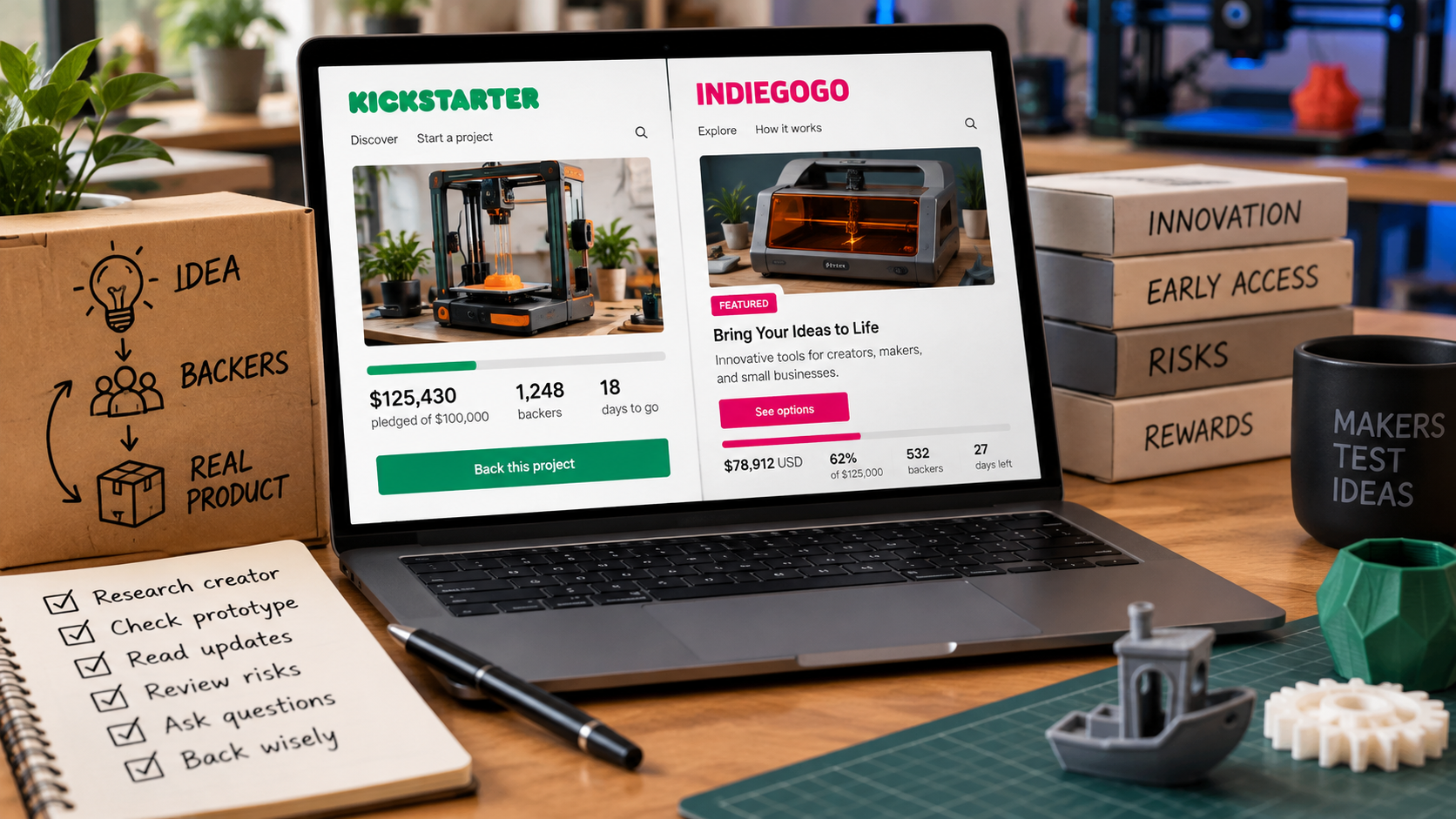
Platforms such as Kickstarter and Indiegogo allow creators to present an idea, establish funding goals, offer rewards, and collect pledges from supporters.
For a product campaign, the basic concept is straightforward:
Idea → Campaign → Backers → Funding → Development → Production → Delivery
The important part is that the product may not exist as a finished, mass-produced item when you back it. You may be looking at a working prototype, an engineering sample, a computer-generated rendering, or some combination of the three. That’s one of the fundamental differences between crowdfunding and ordinary online shopping.
Kickstarter vs. Indiegogo
Kickstarter and Indiegogo are two of the best-known crowdfunding platforms, but they don’t operate identically.
Kickstarter currently uses an all-or-nothing funding model for its standard campaigns. If the campaign doesn’t reach its funding goal by the deadline, backers aren’t charged. Kickstarter also emphasizes that creators remain responsible for actually completing and fulfilling their projects. Kickstarter Blog
Indiegogo offers several campaign and fulfillment options, including regular crowdfunding, Express Crowdfunding, and pledge-management tools. Its current platform documentation also shows that campaign timelines can continue into later pledge and fulfillment stages. Indiegogo Help
For a backer, however, the most important point isn’t necessarily which platform is being used.
The creator and the project matter more than the logo at the top of the campaign page.
Why Back a Crowdfunding Campaign?
There are some very good reasons to back a project.
You may get something genuinely new
Crowdfunding is particularly interesting for products that don’t yet exist in the mainstream market. You may discover a clever tool, piece of technology, hobby product, or other invention months or even years before it becomes widely available—if it ever does.
Early-bird pricing can be attractive
Many campaigns offer lower introductory prices to early backers. The creator gets early funding and momentum, while the backer potentially gets the product for less than its eventual retail price. Potentially is the important word. The eventual retail price may be higher, but there’s no guarantee that the crowdfunding price will ultimately prove to be a bargain.
You can help bring an idea to life
There’s also an intangible benefit. If you think a product should exist, crowdfunding lets you help make it happen. Kickstarter describes backing as helping creators bring something new into existence rather than simply purchasing something already sitting on a store shelf. Kickstarter Blog
The Risks of Crowdfunding
This is the part every potential backer should understand.
Delays Are Common
A campaign might promise delivery in six months. That doesn’t necessarily mean you’ll have the product in six months. Manufacturing problems, component shortages, tooling issues, certification, shipping problems, and unexpected engineering changes can all push a schedule back. A product that looked like a six-month wait can turn into a year—or longer.
The Product May Change
The product you receive may not be identical to the product shown in the campaign. That’s particularly important with technology products. A campaign may show a prototype or early production sample while the final product goes through additional engineering changes. Some changes may improve the product. Others may be compromises required to make manufacturing practical.
The Project Can Fail
This is the biggest risk. A successfully funded campaign isn’t necessarily a successfully completed product. A creator can encounter manufacturing problems, run out of money, discover that the product doesn’t work as intended, or encounter other problems that prevent fulfillment. Kickstarter explicitly tells backers that projects can experience changes and delays and that completion isn’t guaranteed. Kickstarter Legal
You May Not Get a Traditional Retail Experience
When you buy an established product from a major retailer, you’re generally dealing with an existing supply chain, established warranty procedures, and a finished product. Crowdfunding is different. The creator may be a small company producing its first product. That can mean less-established customer service, warranty support, replacement parts, and repair infrastructure.
How to Evaluate a Crowdfunding Campaign
This is where you can dramatically reduce your risk.
1. Research the Creator
Find out who is actually behind the campaign.
Look for:
- Previous products
- Previous crowdfunding campaigns
- Company history
- Manufacturing experience
- Independent reviews
- Complaints or unresolved issues
The FTC specifically recommends researching the organizer and searching for the project and creator alongside terms such as complaint, review, and scam. Consumer Advice
A creator with a history of successfully delivering products deserves a different level of confidence than someone appearing out of nowhere with a polished rendering and no track record. It’s also worth comparing a new crowdfunding product with alternatives that are already available. Our 3D printer comparison is one example of how comparing established products can help put a new technology purchase into perspective.
2. Determine What Actually Exists
This may be the single most important question:
Is there a working prototype?
A beautiful 3D rendering isn’t evidence that a product is ready for manufacturing.
Look for photographs or video of:
- Working prototypes
- Engineering samples
- Production-intent hardware
- Manufacturing equipment
- Actual product testing
The FTC specifically recommends confirming the project’s production status rather than assuming that attractive product images mean the product is finished. Consumer Advice
3. Look at the Manufacturing Plan
A campaign doesn’t need to have every detail figured out, but there should be some indication that the creator understands how the product will actually be manufactured.
Look for information about:
- Manufacturing partners
- Tooling
- Production quantities
- Quality control
- Testing
- Certifications where applicable
- Shipping and fulfillment
A campaign that explains how it intends to manufacture the product is generally more informative than one that focuses entirely on features.
4. Read the Risks and Challenges
Don’t skip the boring section.
Good campaigns should acknowledge that things can go wrong.
Look for realistic discussion of:
- Manufacturing delays
- Supply-chain issues
- Component availability
- Regulatory requirements
- Shipping
- Product revisions
A creator who acknowledges risks isn’t necessarily warning you away.
In fact, realistic discussion of risks can be a positive sign.
5. Read the Comments and Updates
This is one of the easiest things to overlook. Don’t just read the campaign description. Read the updates. Then read some of the comments. You’re looking for how the creator behaves when things don’t go according to plan.
Does the creator:
Communicate openly?
Answer difficult questions?
Acknowledge problems?
Provide meaningful updates?
Or do updates become increasingly vague as the project runs into trouble?
The way a creator handles bad news can tell you more than the original sales pitch.
Red Flags to Watch For
No single red flag proves a campaign is fraudulent or destined to fail, but several together should make you cautious.
🚩 No evidence of a working prototype
Especially when the campaign is supposedly close to production.
🚩 Unrealistically short development timelines
Hardware development and manufacturing generally take longer than marketing campaigns make them sound.
🚩 Extraordinary claims without supporting evidence
Be particularly cautious when performance claims seem far beyond what competing products can achieve.
🚩 Little or no information about the people behind the company
You should be able to determine who is responsible for the project.
🚩 Constantly changing explanations
If the story about manufacturing, delivery, or funding keeps changing, pay attention.
🚩 Avoiding difficult questions
A creator doesn’t have to have every answer, but refusing to acknowledge reasonable questions is concerning.
🚩 The campaign looks more like an advertisement than a development project
A polished presentation is great.
But polish isn’t proof of production readiness.
Crowdfunding vs. Buying an Established Product
Sometimes the biggest question isn’t whether a campaign looks legitimate.
It’s whether you should back it at all.
| Crowdfunding | Established Product | |
|---|---|---|
| Product availability | Future | Usually immediate |
| Price | Often early-bird pricing | Established retail price |
| Product development | May still be underway | Finished |
| Delivery | Estimated | Usually predictable |
| Risk | Higher | Lower |
| Product support | May be developing | Usually established |
| Opportunity to get something new | High | Lower |
| Ability to evaluate finished product | Limited | Usually extensive |
Neither option is inherently better. You’re essentially trading certainty for opportunity. If you need the product next month, crowdfunding probably isn’t the right choice. If you’re excited about a new product, don’t need it immediately, and are comfortable accepting some risk, crowdfunding can be a very interesting way to buy.
One advantage of waiting for an established product is that you can read independent reviews and see how the finished product performs in the real world. For example, our Snapmaker U1 review looks at an actual production machine rather than a product still in development.
A Simple Rule for Deciding Whether to Back
Here’s the approach I like:
Never pledge more money than you’re comfortable losing.
If losing the entire pledge would seriously upset your finances, don’t make the pledge. And don’t let an attractive early-bird price convince you that you’re saving money. You’re not saving money if the product never arrives. Think of crowdfunding as somewhere between shopping and supporting an idea—but without assuming that you will actually receive the promised product.
Crowdfunding Backer’s Checklist
Before backing a campaign, ask yourself:
☐ Who is behind the project?
☐ Have they successfully delivered products before?
☐ Is there a working prototype?
☐ How far along is the product?
☐ How realistic is the delivery date?
☐ Who will manufacture it?
☐ What could cause delays?
☐ What happens if the project fails?
☐ Have I read the campaign updates and comments?
☐ Can I afford to lose the entire pledge?
If you can answer those questions comfortably, you’re in a much better position to decide whether the campaign is worth backing.
Our Take on Crowdfunding
Crowdfunding can be one of the most exciting ways to discover new products. We’ve seen it become a launchpad for everything from games and creative projects to tools, electronics, 3D printers, and other technology. But the excitement can make it easy to forget what you’re actually doing.
You’re backing a project—not buying a finished product off a store shelf.
That distinction is the key to approaching crowdfunding intelligently. Do your research. Look beyond the polished campaign video. Find out who is behind the project, determine how far development has progressed, look for evidence of a real prototype, and pay attention to how the creator communicates when things don’t go according to plan.
If the project succeeds, you may get to experience something genuinely new—and perhaps get it at an attractive early-bird price. If it doesn’t, you should be comfortable knowing that you took a calculated risk to help bring an idea to life.
That’s the tradeoff that makes crowdfunding exciting—and why it deserves a little more homework than ordinary online shopping.